
The average plumbing business loses 67% of calls that come in after hours. At $350 average job value, that's $12,000+ in monthly revenue walking away—straight to competitors with 24/7 answering.
If you're a plumber, this isn't news. You know the pain: it's 2am, your phone buzzes with a burst pipe emergency. Do you answer? Of course you do—because if you don't, they're calling the next plumber on Google. But there's a better way than sacrificing your sleep for every call or watching thousands in revenue disappear into voicemail black holes.
AI operators are changing the game for plumbing businesses. Not chatbots that frustrate customers with canned responses—actual AI assistants that act like a real dispatcher, capturing leads, triaging emergencies, and booking jobs around the clock. And the setup takes less time than a water heater replacement.
Ready to see how plumbers are capturing 94% of leads instead of 40%? Let's dive into exactly how AI operators work, real results from plumbing businesses, and a step-by-step setup guide you can implement this week. Start your free trial at Stay Ahead to see it in action.
Why Traditional Plumbing Businesses Lose 40% of Leads
Plumbing businesses lose jobs when inbound calls, urgency triage, and booking flow rely on manual callbacks. AI works best here by handling the repetitive first-response layer so your team can focus on dispatching, onsite work, and higher-value customer decisions.
The plumbing industry has a lead capture problem. It's not about the quality of your work—it's about timing, availability, and the chaos of running service calls while your phone keeps ringing.
Missed Calls = Missed Revenue
Here's the brutal math: 73% of callers won't leave voicemail. They'll just move down the list and call the next plumber. Emergency jobs go to whoever answers first, period.
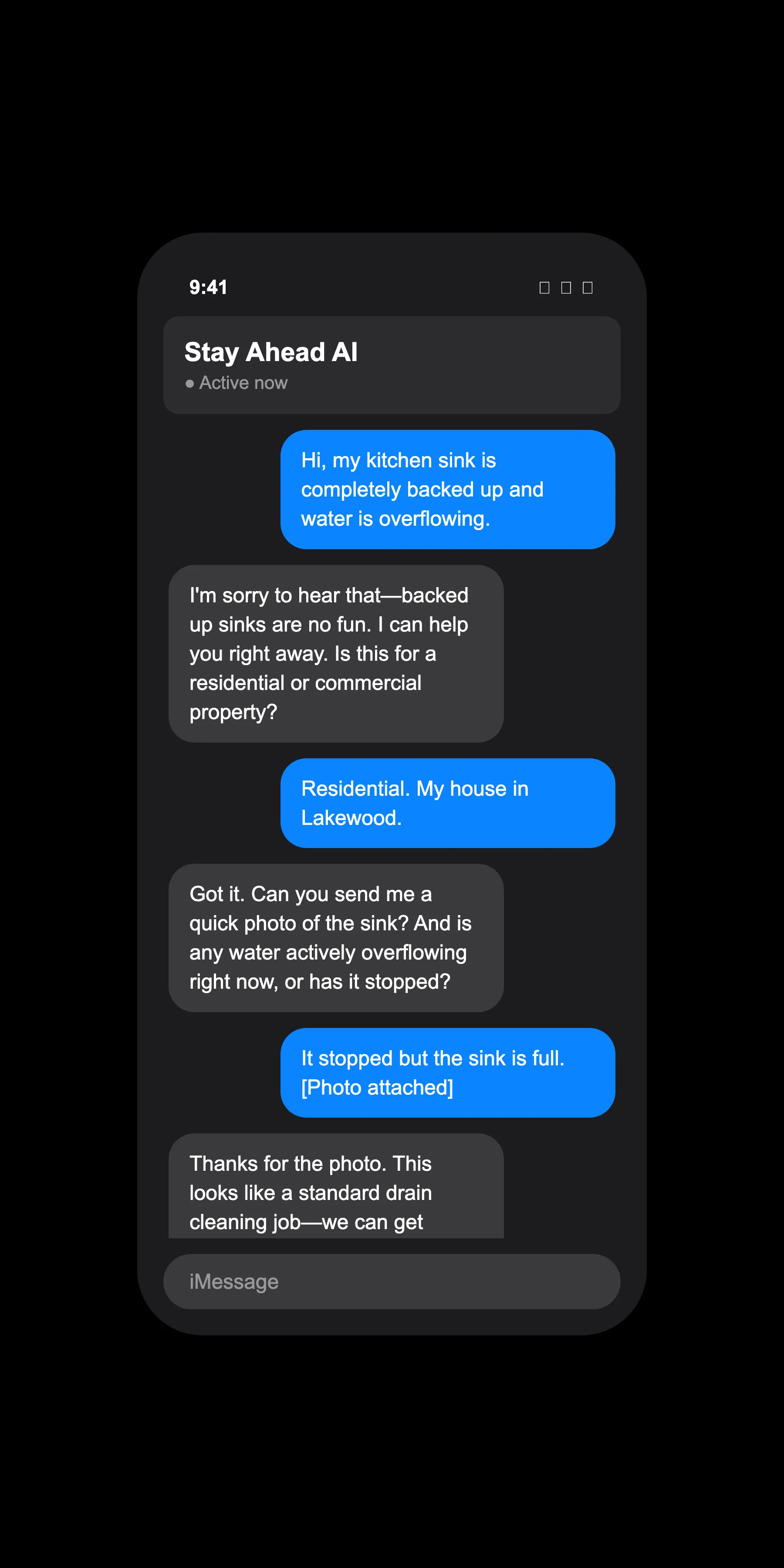
"If I don't answer within 2 rings, they're calling the next guy. People with burst pipes at 11pm aren't waiting around for callbacks." — Mike T., Denver Plumbing
When 40% of plumbing searches happen between 6pm and 8am, that voicemail inbox isn't capturing urgency—it's capturing missed paychecks. The average plumber loses $12,000 to $18,000 per month simply because they're unavailable when customers need them most.
Case Studies: Plumbers Who Automated Lead Capture
Johnson Plumbing (Denver, CO)
The Challenge: Missing 60% of after-hours calls
Rick Johnson runs a 6-person residential plumbing business in Denver. Like most plumbers, he couldn't afford a full-time answering service, but he was hemorrhaging leads after 5pm and on weekends. His voicemail capture rate was dismal—only 40% of callers left messages, and of those, 30% had already hired someone else by the time he called back.
The Solution: AI operator on WhatsApp and SMS
Rick implemented Stay Ahead's AI operator to handle all incoming calls, texts, and WhatsApp messages. The AI was trained on his service menu, pricing for common jobs, and emergency vs. routine triage rules.
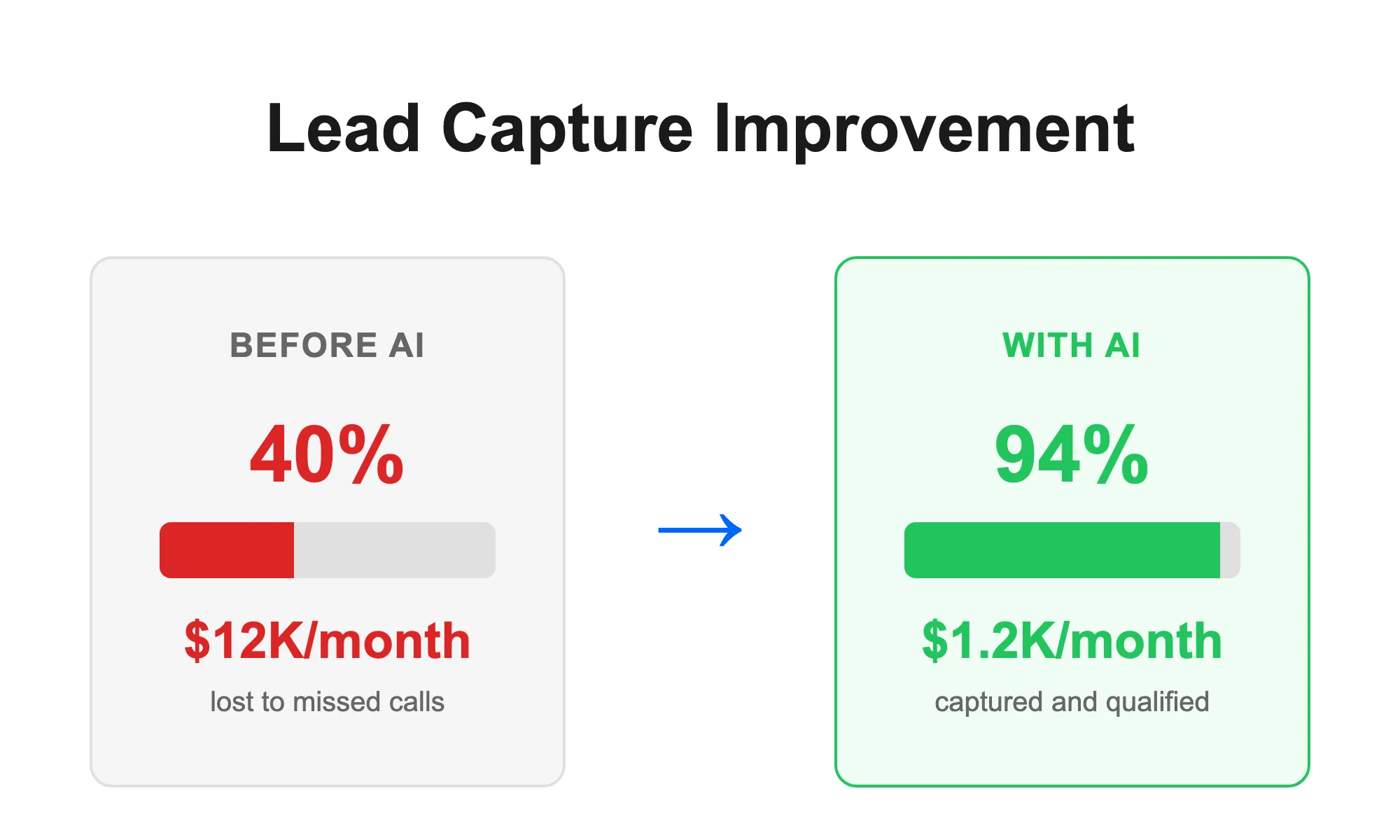
The Results:
- 94% call capture rate (up from 40%)
- $18,000 additional monthly revenue from after-hours jobs alone
- 12x ROI in the first 60 days
- 15 hours per week saved on phone calls and scheduling
"It's like having a dispatcher who never sleeps. Customers love the instant response, and I love waking up to a full calendar instead of a full voicemail box." — Rick Johnson, Owner
What AI for plumbers does not do
AI can remove communication bottlenecks, but it does not replace licensed trade judgment or field execution. It works best as an operations layer around your existing plumbing team.
- It does not replace licensed diagnosis, repair decisions, or onsite workmanship.
- It does not auto-approve legal terms or pricing exceptions without your rules.
- It does not replace dispatch ownership for high-risk emergency scenarios.
- It does not remove the need for quality control and customer care standards.
Setup required before go-live
The fastest plumbing rollouts happen when service categories, urgency rules, and scheduling boundaries are clear before launch. This keeps response quality high and avoids noisy escalations.
- At least one inbound channel live: phone, SMS, web form, or WhatsApp.
- Emergency vs routine triage rules defined by keyword and service type.
- Service-area and availability windows linked to your dispatch schedule.
- Template library for first response, booking confirmation, and follow-up.
Implementation checklist (first 7 days)
- Connect channels and confirm every inquiry receives an immediate response path.
- Configure emergency intent detection and on-call escalation rules.
- Enable booking and rescheduling logic with dispatch-safe time buffers.
- Load pricing guidance for standard jobs and escalation for custom work.
- Review live conversations daily and confirm routing quality by service type.
What AI for plumbers does: 8 workflows that usually create the fastest lift
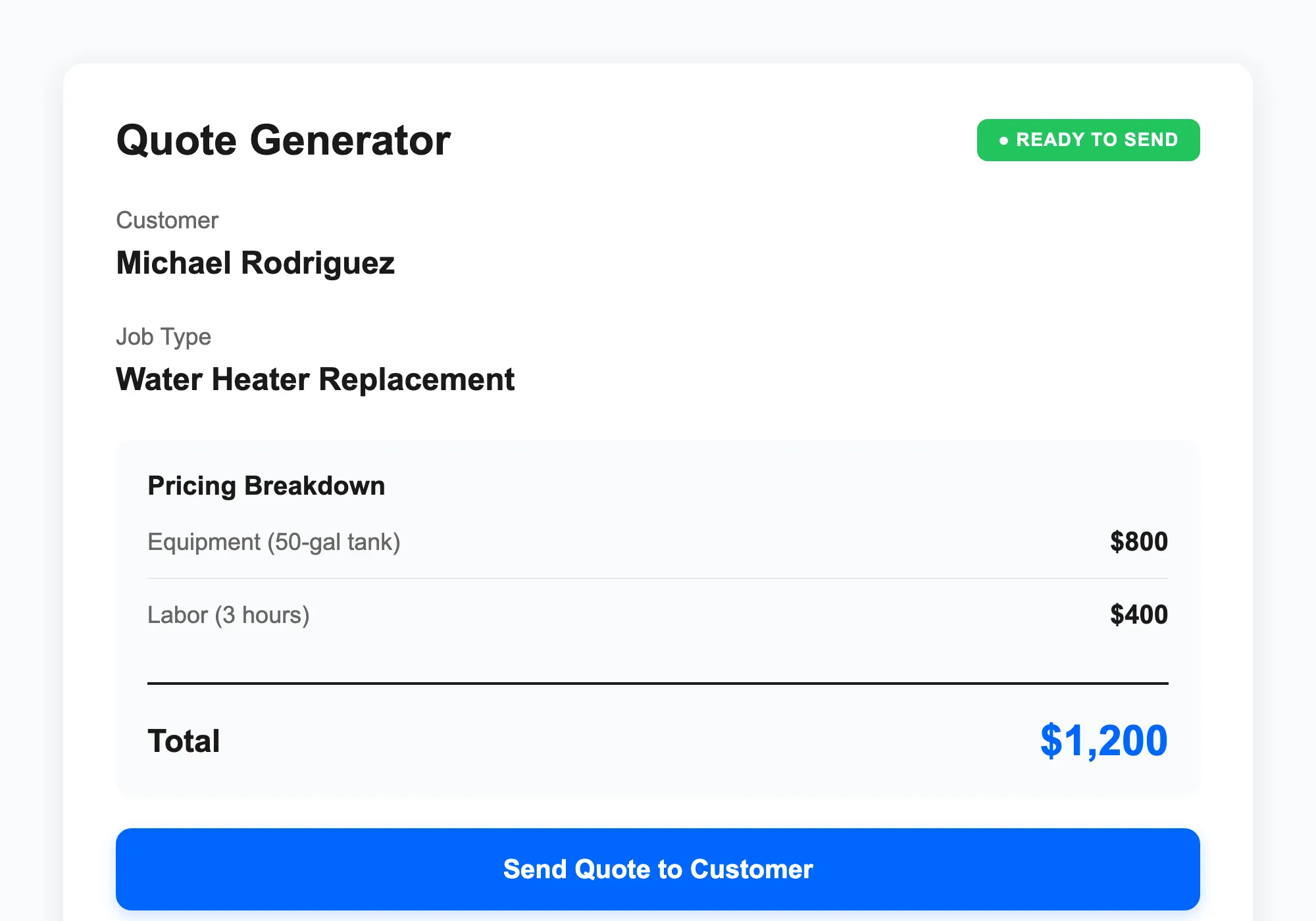
Use one shared quote dashboard to keep response speed and follow-up quality consistent.
Most plumbing teams do not need a complete process reset. They need consistency in response, booking, and follow-up. These workflows typically create the earliest measurable impact.
- After-hours first response: stop losing urgent calls to voicemail.
- Emergency triage: escalate real hazards while filtering routine jobs.
- Booking and rescheduling: reduce call-tag around available slots.
- Pre-visit intake: collect issue details and photos before dispatch.
- Quote follow-up: keep pending jobs warm with timed reminders.
- Completion confirmation: standardize handoff and payment reminders.
- Review requests: trigger post-job review asks consistently.
- Reactivation: bring back dormant leads and previous customers.
When these are active, dispatch stress drops and schedule predictability improves without requiring more admin headcount.
The practical goal is simple: every inbound lead should either be booked, escalated, or intentionally declined with context. That single operating standard removes the biggest revenue leak in plumbing teams, where leads get stuck between voicemail, callbacks, and overloaded dispatch windows.
Emergency vs routine handling model
Plumbing demand splits into urgent incidents and routine service. A strong operating model handles both without overwhelming your on-call team or delaying high-priority incidents.
| Category | Operator action | Outcome |
|---|---|---|
| Emergency | Collect critical details, escalate to on-call immediately. | Faster hazard response and cleaner handoff. |
| Urgent, non-critical | Qualify, prioritize, and offer earliest available windows. | Reduced backlog and fewer missed opportunities. |
| Routine | Book standard slots and send automated confirmations. | Lower scheduling admin and better attendance. |
Get started straight away + self-learning growth plan for plumbing teams
Immediate start: Foundation
- Connect inbound channels and verify first-response behavior.
- Define emergency intent rules and on-call escalation ownership.
- Set dispatch windows and service-area constraints.
Right after connect: Core activation
- Enable booking flow for routine jobs.
- Add quote follow-up reminders for unbooked estimates.
- Validate schedule confirmations and reminder cadence.
Ongoing: Self-learning growth
- Monitor conversation quality while the operator improves from live interactions.
- Add payment follow-up and review request automations.
- Run a short owner checkpoint on a consistent cadence (typically weekly).
How to measure success in the first month
- Speed-to-response: median time to first reply by channel.
- Emergency accuracy: true emergency routing quality.
- Booked-job rate: qualified inquiries converted to confirmed jobs.
- No-show reduction: attendance lift from confirmations/reminders.
- Follow-up completion: quote, payment, and review workflow consistency.
Run a short owner review on a consistent cadence (typically weekly). The operator learns continuously from memory and conversation history, so manual prompt changes stay the exception rather than the default.
Best fit vs not ideal fit
Best fit
- Shops handling regular after-hours and weekend inquiry volume.
- Teams with dispatch pressure and frequent scheduling interruptions.
- Owners focused on better response consistency without more payroll.
Not ideal fit
- Teams with no defined emergency escalation policy.
- Operations unwilling to standardize basic qualification questions.
- Businesses expecting AI to replace onsite technical decisions.
Common rollout mistakes and how to avoid them
Plumbing teams usually do not fail because the idea is wrong. They fail because handling logic is vague at launch. If urgency boundaries, booking ownership, and follow-up templates are unclear, the system becomes noisy and trust drops quickly.
- Over-automation on day one: activating every workflow at once.
- Weak emergency logic: routine issues escalating like true emergencies.
- No owner rhythm: no consistent checkpoint for quality and exceptions.
- Inconsistent templates: messages that do not match real team tone.
- No scoreboard: no tracking for response speed and booking quality.
The fix is simple: launch narrow, set clear escalation ownership, and run short oversight checks on a fixed cadence (typically weekly). Improvements compound naturally as the operator learns from ongoing conversations and stored business memory.
Example operating day with AI handling front-line coordination
A useful stress test is mapping one full day. This reveals where communication bottlenecks are removed and where human oversight still matters most.
- 6:00-8:00 AM: overnight inquiries get triaged and organized by urgency.
- 8:00-11:00 AM: routine jobs get booked with confirmation details.
- 11:00 AM-2:00 PM: quote requests and follow-up reminders keep pipeline moving.
- 2:00-5:00 PM: dispatch updates and schedule adjustments are communicated automatically.
- After hours: emergency paths stay active while routine jobs queue cleanly for next day.
This model is where teams typically see early lift: fewer missed calls, fewer schedule gaps, and better handoff quality between inbound communication and field delivery.
Channel mix that usually performs best for plumbers
Most high-performing teams use a simple channel mix instead of overcomplicated stacks. Keep one primary path for urgent response and one backup path for low-friction booking.
- Phone + SMS: strongest for emergency-first demand and dispatch speed.
- Web form + SMS: effective for routine service and quote follow-up.
- Messaging apps: useful when customers prefer async updates and photos.
The key is consistency, not channel count. Response quality, escalation accuracy, and booking reliability matter more than adding every possible channel in week one.
If volume is high, start with two channels you can govern tightly, not five channels you cannot monitor. A disciplined channel strategy gives cleaner data, better dispatch handoff, and faster optimization than broad multichannel sprawl.
In practice, most teams improve faster by standardizing language and escalation expectations per channel than by adding more channels. Operational clarity scales better than channel complexity.
Keep your first quarter focused on reliability: consistent first response, accurate triage, and clean booking handoff. Once those stabilize, expansion into deeper follow-up automations becomes much easier to govern.
Reliable operations beat flashy complexity for plumbing teams.
FAQ: AI Operators for Plumbers
Does it work with my existing booking system?
Yes. AI Operator integrates with Google Calendar, Jobber, ServiceTitan, Housecall Pro, and 40+ other plumbing software platforms. If you use something custom, we can connect via API or Zapier in under 10 minutes. Your existing workflow stays the same—the AI just automates the communication layer.
What if a customer wants to talk to a real person?
The AI explains it's an assistant and offers to connect them to you immediately for complex issues. For 87% of calls (simple booking requests and standard quotes), customers actually prefer the speed—they get answers and appointments in 2 minutes instead of waiting hours for a callback. Emergency calls are routed to your on-call tech within 30 seconds with all details captured.
How much does it cost vs hiring a dispatcher?
Stay Ahead costs $24/month. A part-time dispatcher costs $2,000+/month and can't work 24/7. Most plumbers see 8-15x ROI in the first 60 days from captured after-hours leads alone. At $350 average job value, you only need to capture 1-2 additional jobs per month for the AI to pay for itself. Most plumbers capture 15-30 extra jobs per month with 24/7 coverage.
More AI Solutions for Trade Businesses
Stop Losing $10K+/Month to Missed Calls
Every call that goes to voicemail is $350 walking out the door. Every after-hours emergency that you miss is going to the plumber who answers first.
Sign up with email, choose a plan, and add your card to start your 7-day free trial. Cancel anytime.
Related Articles
AI for Electricians: Never Miss a Bid 24/7
How electrical contractors win 48% of bids with 6-minute response times
AI for Contractors: Handle 47 Daily Tasks Without Chaos
How contractor teams reduce coordination overload and improve response speed
How AI Operators Work
The complete guide to AI-powered customer communication for service businesses